Governing Body & Contact
Editorial Policies
Submissions
License

This work is licensed under a Creative Commons Attribution-NonCommercial-ShareAlike 4.0 International License .
..:: TOOLS ::..




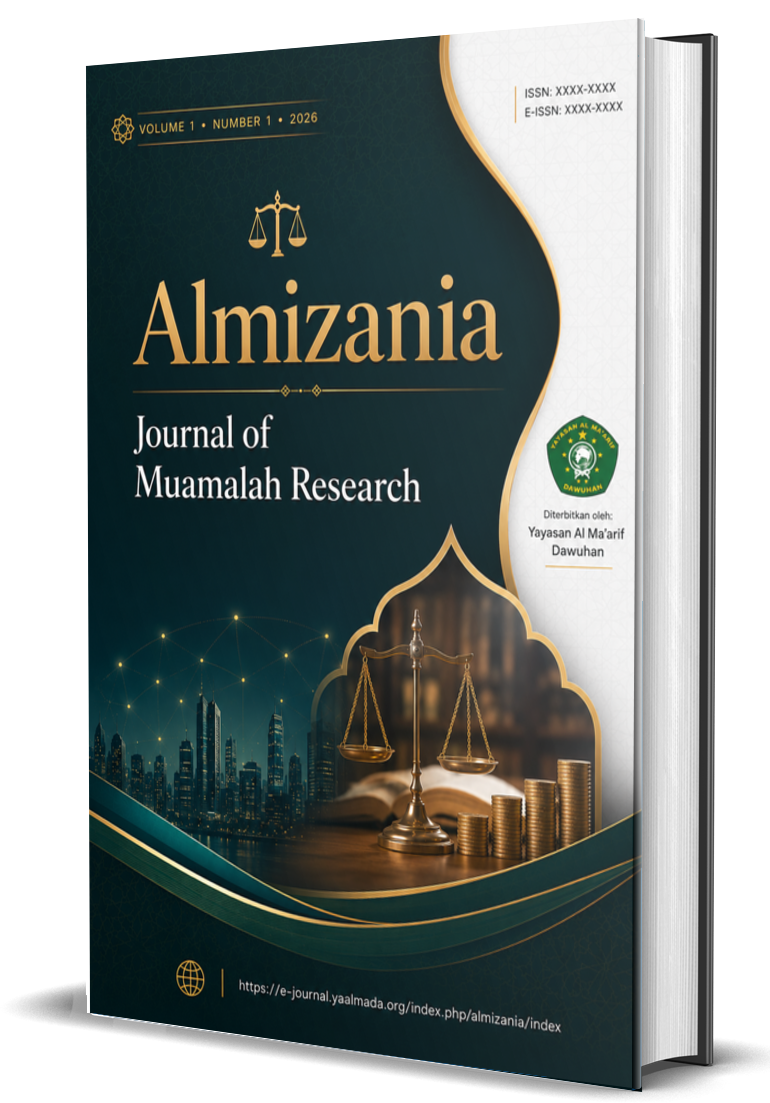
| Original title | : | Almizania: Journal of Muamalah Research |
| Abbreviation | : | Almizania: Journal of Muamalah Research |
| Short title | : | elmuamalah |
| Indexing | : | Google Schoolar |
| Publication Frequency | : | 2 issues per year |
| Archiving | : | Public Knowledge Project Private LOCKSS Network (PKP-PLN) - see the LOCKSS Publisher Manifest |
| DOI | : | - |
| ISSN | : | - |
| Management Style | : | Open Access |
| Editor in Chief | : | Prof. Dr. Ali Murtadho, M.Ag |
| Publisher | : | Yayasan Al Ma'arif Dawuhan |
| Citation Analysis | : | |
| Language | : | English & Indonesia |
| Discipline | : | Islamic Banking and Finance, Islamic Commercial Law, Islamic Social Finance, Islamic Microfinance, Islamic Ethics in Business, Legal Issues in Islamic Economic Transactions. and Others |
Almizania: Journal of Muamalah Research is a double blind peer reviewed journal published by Yayasan Al Ma'arif Dawuhan Indonesia. This journal is a scholarly publication dedicated to the exploration and dissemination of research findings in the field of Shariah-compliant economic law. The journal serves as a platform for academics, researchers, and practitioners to engage in rigorous discourse on various aspects of Islamic economics, finance, and business law. Published regularly, Almizania aims to advance knowledge and understanding of the intricate intersections between Islamic principles and contemporary economic practices. The journal welcomes original research articles, theoretical analyses, empirical studies, and critical reviews that contribute to the development of Islamic economic jurisprudence and its practical applications. With a commitment to academic excellence and intellectual rigor, Almizania publishes articles that delve into a wide range of topics including but not limited to Islamic banking and finance, Islamic commercial law, Islamic social finance, Islamic microfinance, Islamic ethics in business, and legal issues pertaining to Islamic economic transactions. Each submission undergoes a thorough peer-review process to ensure scholarly integrity and adherence to academic standards. By fostering scholarly exchange and collaboration, Almizania endeavors to enrich scholarly discourse, promote innovation, and advance the global understanding of Islamic economic principles within the framework of contemporary legal and economic systems.