ISSN
Governing Body & Contact
Editorial Policies
Submissions
Additional Information
License

Creative Commons BY-NC-SA 4.0
Visitor Statistics
..:: TOOLS ::..





The peer review process for Peradaban: Journal of Public Service follows a rigorous and transparent evaluation system to ensure the quality and integrity of published articles. Upon submission, the editorial team conducts an initial assessment to determine whether the manuscript aligns with the journal’s focus and scope. Manuscripts are also checked for plagiarism using plagiarism detection software, and those with high similarity scores are either rejected or returned for revision. If the manuscript meets the basic requirements, it proceeds to the double-blind peer review stage.
In this stage, the manuscript is reviewed by at least two independent experts in the relevant field, ensuring anonymity for both authors and reviewers to maintain an unbiased evaluation. Reviewers assess the manuscript based on originality, methodological rigor, clarity, significance, and relevance to community service and applied research. They provide one of the following recommendations: accept without revision, accept with minor revisions, revise and resubmit (major revisions required), or reject. The editorial team compiles the reviewers' feedback and communicates the decision to the author.
If revisions are required, authors must submit a revised version of the manuscript along with a response letter addressing each reviewer’s comments. Depending on the extent of the revisions, the updated manuscript may be sent back to the original reviewers for further evaluation. The final decision is made by the Editor-in-Chief based on reviewer feedback and the quality of the revised manuscript. Once accepted, the manuscript undergoes copyediting to enhance language clarity and ensure adherence to formatting guidelines. Authors are given a final proof to check for any typographical or formatting errors before publication. The final version of the article is then published online, assigned a DOI, and indexed in relevant academic databases. This structured peer review process guarantees that all published articles maintain high academic and ethical standards, contributing significantly to the field of community service research and applied studies.





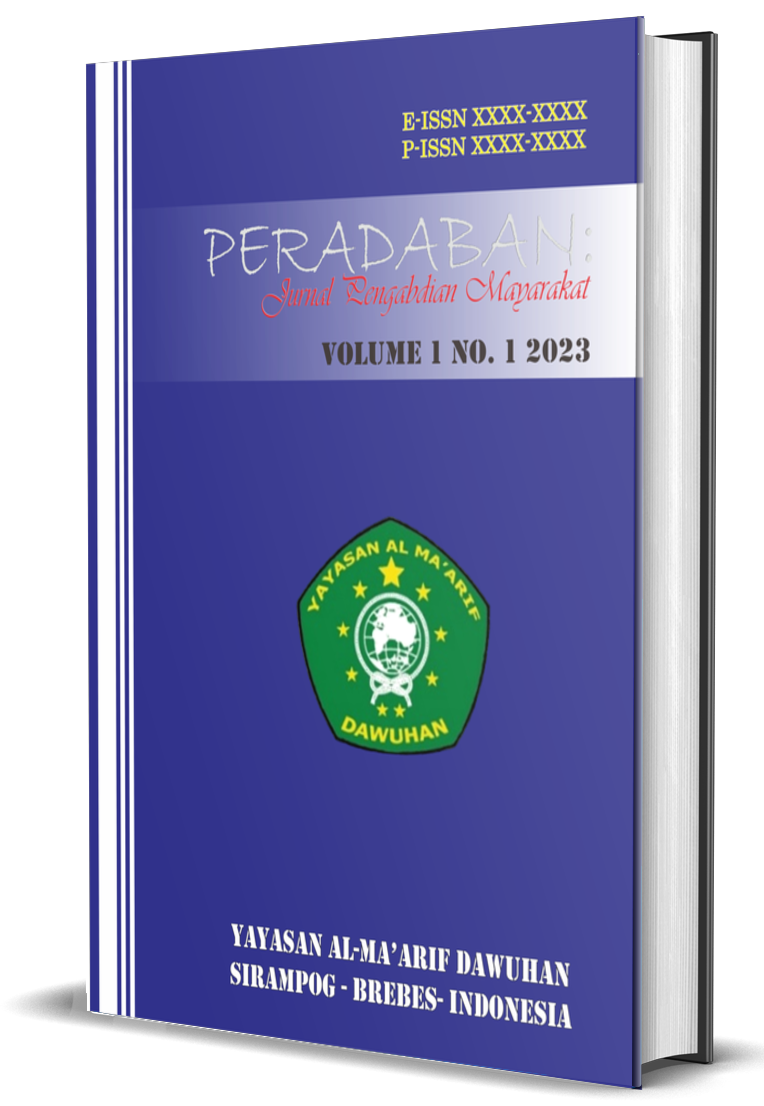
Peradaban: Jurnal Pengabdian Masyarakat
PUBLISH BY CENTER OF PUBLICATION AND PUBLISHING
YAYASAN AL MA'ARIF DAWUHAN
Jln. Paingan Desa Dawuhan Kec. Sirampog Kab. Brebes Jawa Tengah Indonesia 52272
Copyright @ 2024 Yayasan Al Ma'arif Dawuhan | Rumah Jurnal Yayasan Al Maarif Dawuhan