Governing Body & Contact
Editorial Policies
Submissions
Additional Information
Journal History
Indexing and Abstracting
Visitor Statistics
License

Creative Commons BY-NC-SA 4.0
ISSN
Tools





Multidisciplinary Journal of Contemporary Islamic Discourse (MJCID) welcomes high-quality scholarly manuscripts that contribute to the advancement of knowledge in contemporary Islamic discourse and related multidisciplinary fields. Authors are expected to carefully follow the guidelines below when preparing and submitting their manuscripts.
MJCID accepts the following types of manuscripts:
Submissions may address, but are not limited to, the following areas:
Manuscripts must be written in English or Bahasa Indonesia. Authors whose first language is not English are strongly encouraged to have their manuscripts professionally edited prior to submission to ensure clarity and academic quality.
Structure of the Manuscript:
The abstract must clearly state the research purpose, methodology, principal findings, and main conclusion. If the manuscript is written in Bahasa Indonesia, an English abstract must also be provided.
All listed authors must have made substantial scholarly contributions to the research and writing process. Full names, institutional affiliations, ORCID IDs (if available), and contact details of the corresponding author must be provided at submission.
Submitted manuscripts must be original, unpublished, and not under consideration by any other journal. All submissions will undergo plagiarism screening using similarity detection software. Manuscripts with a similarity index exceeding 20% (excluding references and properly quoted material) may be rejected without further review.
Manuscripts must be submitted through the journal’s official online submission system. Authors must register as users before submitting their manuscript. Submissions sent via email will not be processed.
All manuscripts undergo a double-blind peer review process. Authors are expected to revise their manuscripts in accordance with reviewer comments within the specified timeframe. The final decision regarding publication rests with the Editor-in-Chief based on reviewers’ recommendations and editorial evaluation.
Upon acceptance, authors retain copyright and agree to publish their work under the Creative Commons Attribution 4.0 International License (CC BY 4.0), allowing unrestricted use, distribution, and reproduction in any medium, provided the original work is properly cited.
Authors must adhere to ethical research standards, disclose any potential conflicts of interest, and acknowledge all sources of funding. Research involving human participants must comply with applicable ethical guidelines and institutional review standards.
Failure to comply with these guidelines may result in the rejection of the manuscript at any stage of the review or publication process.





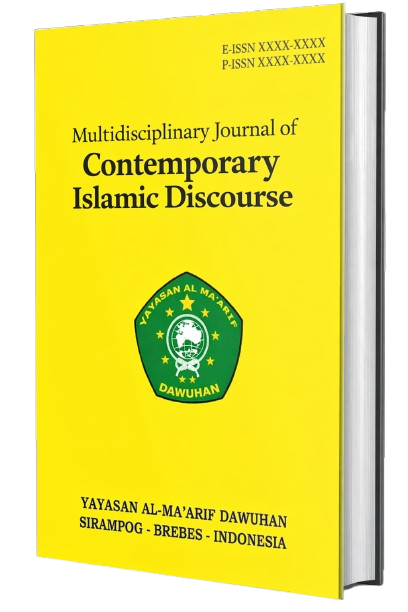
Multidisciplinary Journal of Contemporary Islamic Discourse
PUBLISH BY CENTER OF PUBLICATION AND PUBLISHING
YAYASAN AL MA'ARIF DAWUHAN
Jln. Paingan Desa Dawuhan Kec. Sirampog Kab. Brebes Jawa Tengah Indonesia 52272
Copyright @ 2024 Yayasan Al Ma'arif Dawuhan | Rumah Jurnal Yayasan Al Maarif Dawuhan